Chapter 1: The Wound and the Story of Suffering
From Part I, The Cracking Open. Metameza Ushi.
Part 1: The Wound
TRAUMA: THE ETCHING OF THE BODY/MIND
Trauma is the groove or etching that something that happened in the past leaves in the depths of the body/mind complex.
Trauma is the groove or etching that an event leaves in the body/mind complex, and many times, its origin lies in something that happened to us personally, such as a traumatic event we experienced as children.
However, we also inherit trauma from family, religion, or culture. For instance, if a group of people has been persecuted for generations, that collective trauma can be passed on from one generation to the next. Why? Because we are not only bodies born from bodies; we are also minds born from minds.
The content of any mind passes itself on, or at least some of its content, particularly deep-seated trauma, which can then pass from one generation to the next. The consequence is that trauma is felt in the experience of the body/mind complex of subsequent generations.
Through mindfulness and meditation, we come to realize that much of the trauma we have personally suffered does not necessarily have a personal origin.
Minds are also shaped by the collective and interconnected field, which includes our family, the media we pay attention to, our culture, our nation, and our race. How does this relate to Consciousness?
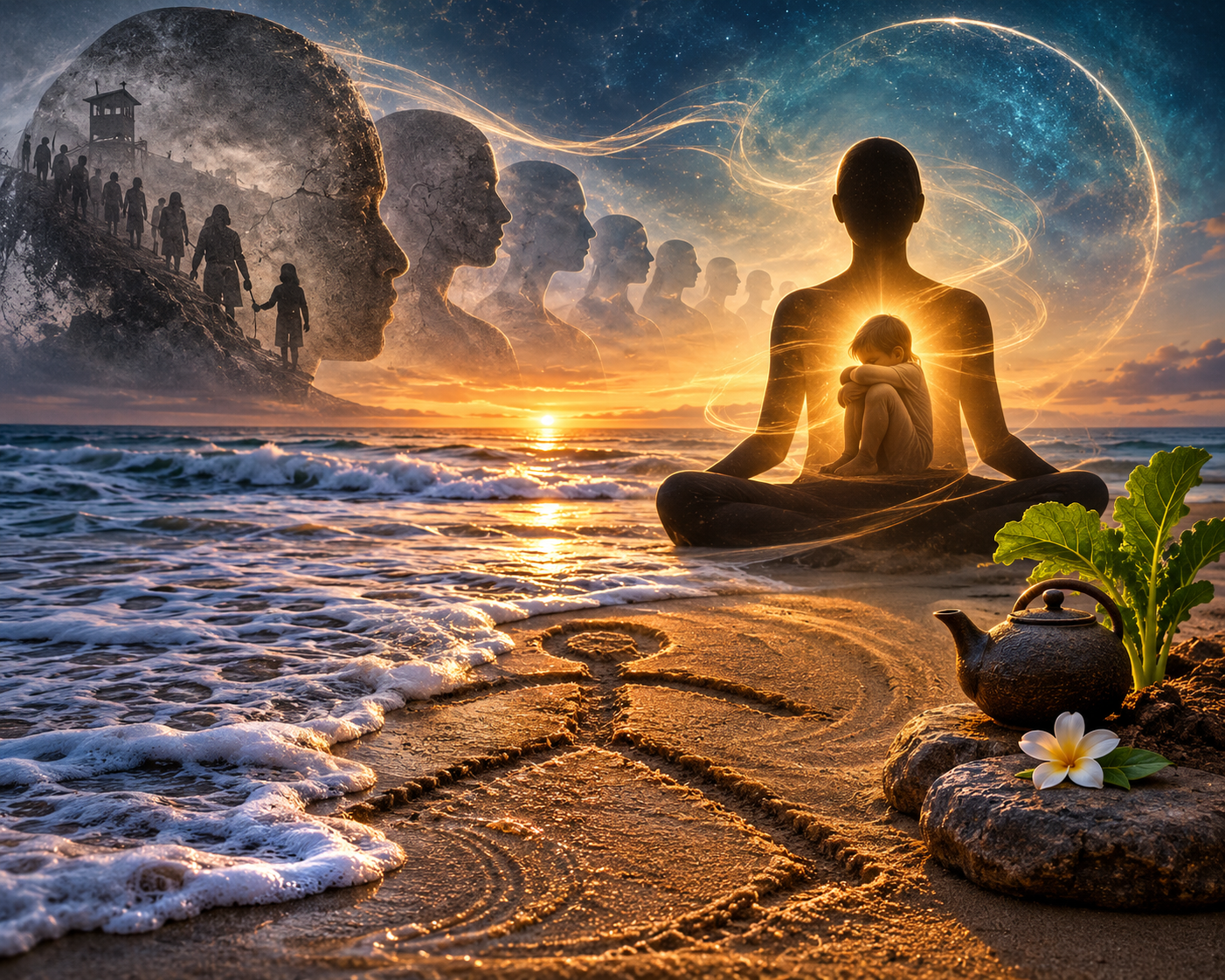
Imagine a stick figure deeply etched into the sand at the beach. The deeper the etching, the less readily it is washed away by the waves. The waves have to pass over it many times before the etching finally washes away and disappears.
Meditation is the bathing of these deeply etched drawings in the body/mind complex with the warm and healing waters of loving awareness.
As Thich Nhat Hanh suggests:
"Go back and take care of the wounded child inside of us. We have to practice going back to our wounded child every day. We have to embrace him or her tenderly, like a big, loving brother or a big sister. We have to talk to him, talk to her. And we can even write a letter to the little child in each of us, of two or three pages, so that we recognize his or her presence and will do everything we can to heal his or her wounds."
In other words, any feelings that arise in meditation, whether compassion, fear, pleasure, anger, shame, guilt, laughter, or irritation, should be welcomed, recognized, and treated on an absolutely equal basis because all of them are ourselves.
"The tangerine I am eating is me. The mustard greens I am planting are me. I plant with all my heart and mind.
I clean this teapot with the kind of attention I would have were I giving the baby Buddha or Jesus a bath. Nothing should be treated more carefully than anything else.
That is to say, at all times, and most especially during mindfulness and meditation practice, all traumas, compassion, fears, irritations, guilt, shame, mustard green plants, and teapots are all absolutely sacred." Thich Nhat Hanh
Metameza Ushi
Discovering Our True Nature