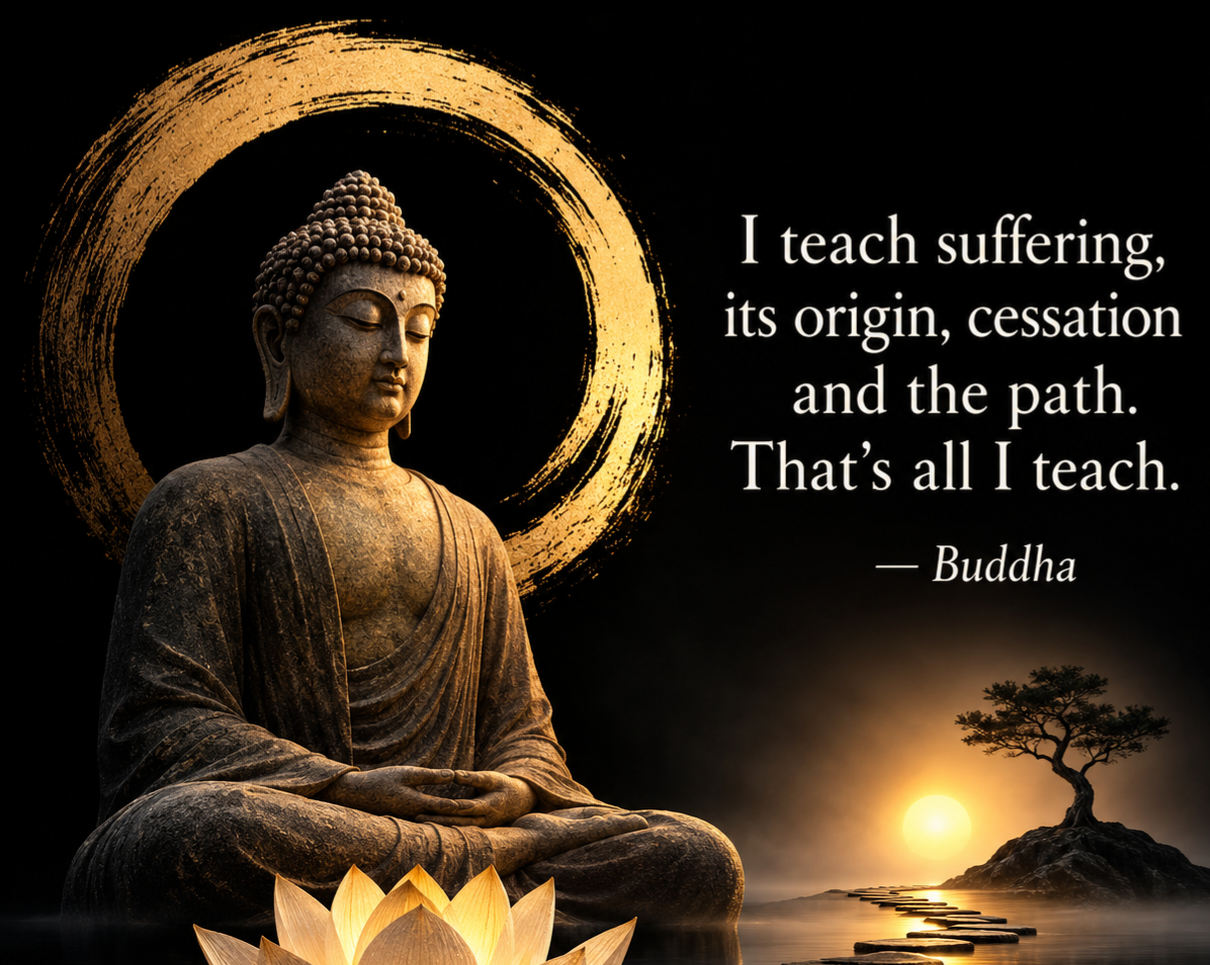
I TEACH SUFFERING, ITS ORIGIN, CESSATION, AND THE PATH. THAT'S ALL I TEACH.
Buddha
“I teach suffering, its origin, cessation, and the path. That's all I teach,” declared the Buddha 2,500 years ago.
The Four Noble Truths contain the essence of the Buddha's teachings. It was these four principles that the Buddha came to understand during his meditation under the Bodhi tree.
Of all the maps of Buddhist psychology, the Noble Truths, which teach the understanding of suffering and its end, are the most central.
The whole purpose of Buddhist psychology, its ethics, philosophy, practices, and community life is the discovery that freedom and joy are possible in the face of the sufferings of human life.
The Four Noble Truths are laid out like a psychological diagnosis: the symptoms, the causes, the possibility of healing, and the medicinal path.
THE FOUR NOBLE TRUTHS AND THE EIGHTFOLD PATH
I. Suffering does exist.
II. Suffering arises from attachment to desires.
III. Suffering ceases when attachment to desire ceases.
IV. Freedom from suffering is possible by practicing the Eightfold Path:
Right understanding (view).
Right intention (thought).
Right speech.
Right action.
Right livelihood.
Right effort.
Right mindfulness.
Right meditation (concentration).
As long as there is consciousness, both the potential to become enlightened and the potential to suffer exist.
When we first hear that suffering is a Noble Truth, one might reasonably wonder, “What's so noble about suffering?” The Buddha's Four Truths are called noble because they liberate us from suffering. They are the Buddha's basic teaching, encapsulating the entire Buddhist path.
What the Buddha was really saying is that if we can recognize suffering, embrace it, and look deeply into its roots, then we'll be able to let go of the habits that feed it and, at the same time, find a way to happiness.
“Suffering has its beneficial aspects. It can be an excellent teacher.”
Thich Nhat Hanh
1. ALL EXISTENCE IS SUFFERING
The word dukkha has been variously translated as “suffering,” “anguish,” “pain,” or “unsatisfactoriness.”
Dukkha means suffering at all levels. Of course, everyday suffering is present: pain, difficulties, illness, and discomfort. But dukkha has more to do with psychological suffering, the sense of dissatisfaction that is very deeply rooted in our psyche.
Suffering comes in many forms. Three obvious kinds of suffering correspond to the first three sights the Buddha saw on his first journey outside his palace: old age, sickness, and death.
But according to the Buddha, the problem of suffering goes much deeper. Life is not ideal; it frequently fails to live up to our expectations.
The Buddha's insight was that our lives are a struggle, and we do not find ultimate happiness or satisfaction in anything we experience.
Human beings are subject to desires and cravings, but even when we are able to satisfy these desires, the satisfaction is only temporary. Pleasure does not last, or, if it does, it becomes monotonous.
Even when we are not suffering from outward causes like illness or bereavement, we are internally feeling unfulfilled or unsatisfied. This is the truth of suffering. This is the problem of existence.
The Buddha's summary, that the five aggregates subject to clinging are suffering, really takes it to the deepest level. He meant that everything about us, all of our mental and physical constituents, is suffering because we cling to them in some form.
2. THE CAUSE OF SUFFERING IS CRAVING
The Second Noble Truth describes the cause of suffering: grasping. Grasping, the Buddha explains, gives birth to aversion and delusion, the three roots of all unhealthy states.
Our day-to-day troubles may seem to have easily identifiable causes: thirst, pain from an injury, sadness from the loss of a loved one.
In the second of his Noble Truths, though, the Buddha claimed to have found the cause of all suffering, and it is much more deeply rooted than our immediate worries.
The Buddha taught that the root of all suffering is desire, tanhā. This comes in three forms, which he described as the Three Roots of Evil, or the Three Poisons.
From these three roots arise all other unhealthy states, such as jealousy, anxiety, hatred, addiction, possessiveness, and shamelessness. These are the causes of individual and global suffering.
The Three Poisons of hatred, greed, and ignorance are shown in a circle, each reinforcing the others.
THE THREE ROOTS OF EVIL
These are the three ultimate causes of suffering:
Greed and desire, represented in art by a rooster.
Ignorance or delusion, represented by a pig.
Hatred and destructive urges, represented by a snake.
The natural human tendency is to blame our difficulties on things outside ourselves. But the Buddha says that their actual root is to be found in the mind itself. In particular, our tendency to grasp at things, or alternatively to push them away, places us fundamentally at odds with the way life really is.
Clinging to a problem does not make it disappear but rather makes it worse, aggravating the problem and leading to frustration and anger in relation to the problem and even in relation to ourselves.
We see things as existing permanently and cling to anything that reinforces our concept of permanence, pushing away anything that threatens it.
Attachment and aversion are the roots of all other problems, and they themselves are caused by ignorance. Ignorance is not intrinsic but rather comes about due to the influence of adopted beliefs and the culture we are raised in.
Thus, ignorance, attachment, and aversion, what Buddhism calls the Three Poisons, are the origin (the Second Noble Truth) of suffering (the First Noble Truth).
3. THE CESSATION OF SUFFERING COMES WITH THE CESSATION OF CRAVING
As we are the ultimate cause of our difficulties, we are also the solution. The causes and conditions that produce a phenomenon contain the seed for its destruction. So, while we cannot change the things that happen to us, we can change our responses.
Realizing that this problem is only temporary, like all things, and that it too will pass, gives us more space to find ways to resolve it. The Buddha taught that the way to extinguish desire, which causes suffering, is to liberate oneself from attachment.
This is the Third Noble Truth: the possibility of liberation. The Buddha was a living example that this is possible in a human lifetime.
“Bhikkhus, when a noble follower who has heard (the truth) sees thus, he finds estrangement in the eye, finds estrangement in forms, finds estrangement in eye-consciousness, finds estrangement in eye-contact, and whatever is felt as pleasant or painful or neither-painful-nor-pleasant that arises with eye-contact for its indispensable condition, in that too he finds estrangement.”
The Fire Sermon (SN 35:28), translated by Ñāṇamoli Thera. © 1981 Buddhist Publication Society.
“Estrangement” here means disenchantment: a Buddhist aims to know sense conditions clearly as they are, without becoming enchanted or misled by them.
4. THERE IS A PATH THAT LEADS FROM SUFFERING
Although the Buddha throws responsibility back onto the individual, he also taught methods through which we can change ourselves, for example, the Noble Eightfold Path.
The Buddha's Noble Eightfold Path is a further “unpacking” of the Threefold Way and is perhaps the most widely known of the Buddha's teachings.
It is ancient, extending back to the Buddha's first discourse, and is highly valued as a treasury of wisdom and practical guidance on how to live our lives.
Traditionally, the teaching is seen as highlighting eight areas or “limbs” of “right” practice (Sangharakshita prefers “perfect” to “right”), which sit in mutual relationship to one another and are each essential elements in an integrated approach to the Dharma:
Right Understanding or Perfect Vision.
Right Resolve or Perfect Emotion.
Right Speech or Perfect Speech.
Right Action or Perfect Action.
Right Livelihood or Perfect Livelihood.
Right Effort or Perfect Effort.
Right Mindfulness or Perfect Awareness.
Right Meditation or Perfect Samadhi.
THE PATH
(By Buddha)
Best of the Paths is the eightfold,
Best of the Truths the four;
Best of the Virtues is freedom from attachment;
Best of the Individuals is the One who sees.
This is the Path; there is no other that leads to the purifying of insight.
Follow this Path, and Mara (the Mind) will be confused.
If you follow this Path, you will end your suffering.
This Path was preached by me, Buddha, when I became aware of the removal of the thorns.
You, yourself, must make the effort.
The Perfected Ones are only preachers.
Those who enter the Path and
practice meditation are released
from the bondage of Mara (the Mind).
“All created things perish.” Whoever realizes this transcends pain; this is the clear path.
“All created things are sorrow.” Whoever realizes this transcends pain; this is the clear path.
“All forms are unreal.” Whoever realizes this transcends pain; this is the clear path.
Whoever does not rise when it is time to rise, who, though young and strong, is lazy, who is weak in will and thought, that lazy and idle person will not find the path of wisdom.
Watching one's speech, restraining well the mind, let one not commit any wrong with one's body.
Whoever keeps these three roads of action clear will make progress on the path taught by the wise.
Through meditation, wisdom is gained;
through lack of meditation, wisdom is lost.
Whoever knows this double path of progress and decline should place oneself so that wisdom will grow.
Cut down the forest of desires, not just a tree; danger is in the forest.
When you have cut down the forest and its undergrowth, then, mendicants, you will be free.
As long as the desire, however small, of a man for women is not destroyed, so long is his mind attached, like a sucking calf is to its mother.
Cut out the love of self (ego) like an autumn lotus, with your hand.
Cherish the path of peace. Nirvana has been shown by the Buddha.
“Here I shall live in the rain, here in winter and summer.” Thus thinks the fool, not thinking of death.
Death comes and carries off that person who is satisfied with one's children and flocks, whose mind is distracted, like a flood carries off a sleeping village.
Sons are no help, nor a father, nor relations; for one who is seized by death, there is no safety in family.
Understanding the meaning of this, the wise and just person should quickly clear the path that leads to Nirvana.