IS SUFFERING AN ILLUSION?
The Illusion of the Separate Self and the Nature of True Freedom:
The famous Indian sage Ramana Maharshi had a saying that goes something like this: "One cannot attain liberation by trying to pluck each leaf off a tree, because more leaves will continue to grow. To attain liberation, the whole tree must be uprooted."
In other words, we can try to transcend the ego by dealing with one thought at a time. This may help us make some progress, but it will not ultimately lead to true and lasting freedom.
To be fully liberated from the illusion of the separate self, the person itself must be recognized as an illusion.
There is no greater inner peace than coming to the realization that this little "me," which we have taken ourselves to be our entire lives, does not actually exist. And it is this little "me" that is responsible for all the psychological suffering we have ever experienced. But understanding why the little "me" is an illusion can be difficult for most people.
One of the most misunderstood terms in spirituality is the word "illusion." Phrases such as "the world is an illusion" or "suffering is an illusion" often trigger anger because people think they mean or suggest that what happened to them never actually happened, or that they somehow made it all up. This is a misunderstanding of what the word illusion means, and it deserves to be addressed.
To simplify the concept, it is worth remembering that the concept is not the freedom, in the same way that the map is not the territory. All these words can do is point you toward a realization. Ultimately, it is something you must see for yourself. It is that "aha" moment, that insight, in which you recognize the illusion for what it is. And that, and that alone, is what brings true liberation and freedom.
The phrase "suffering is an illusion" is one of the most empowering and liberating truths we can hear. An illusion is something whose apparent existence depends upon our not understanding it. The moment we understand an illusion, it vanishes because understanding undoes illusions.
Let's use a piece of rope as an example. Someone ties a knot in the middle of the rope and asks us, "Does the knot exist?" We might say, "Yes, of course it exists. I can see it right there."
The mind identifies what appears to be a new object called a knot. But then someone says to us, "No, the knot doesn't exist. It's an illusion." We might react by saying, "How dare you insult my intelligence! I can see the knot right there. You must take me for a fool."
But that is essentially how most people react when they hear the phrase "suffering is an illusion." It doesn't mean that we don't experience suffering, because we obviously do, just as we experience a knot once we identify it as something separate.
What the phrase "the knot is an illusion" actually means is that there is no knot apart from the rope. The knot is simply something the rope is doing. It gives the impression that there are two separate things, one called "rope" and another called "knot," when, in fact, there is only the rope.
In the same way, we can begin to understand why the concept of the person, the personal "me, myself, and I" that we take ourselves to be, is also an illusion.
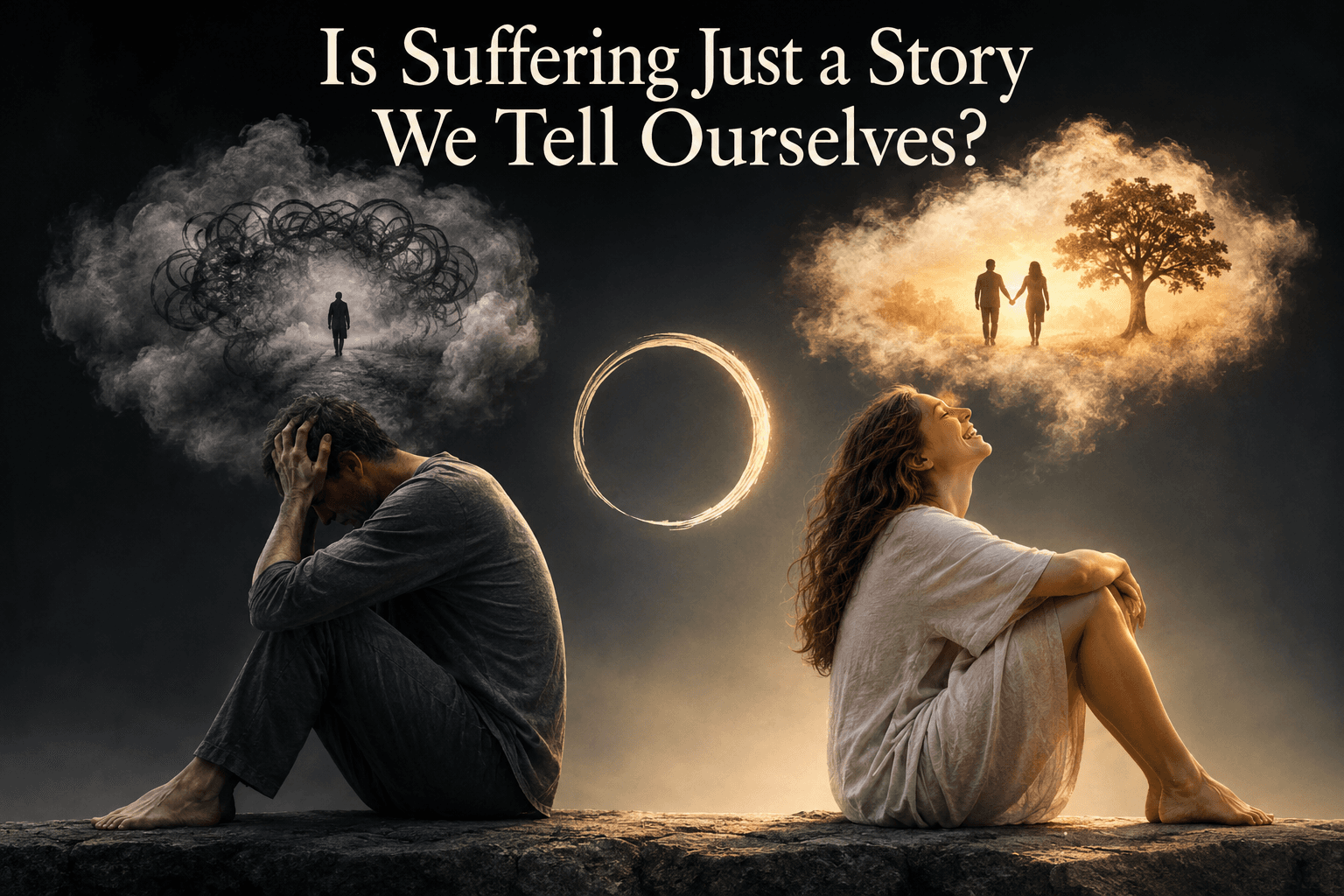
The person is a story. Our entire sense of personhood, which we take to be real, is constructed from memory. There is no "person" or "me" apart from that story. If we remove the story, the person goes with it.
When we think about our past, the way we remember it is remarkably similar to our dreams at night. Memories appear as ephemeral images in the mind, snapshots of moments in time whose accuracy and reliability we cannot always be sure of.
Nevertheless, the mind wants to carry these memories forward and create stories out of them that define who I am in this moment. Yet all stories are illusions. They do not exist apart from our thinking about them. Only this moment exists, and in every moment we are born again, free to be who we choose to be now, free from the dreams of the past.
What remains when the story and the concept of personhood fall away is only this present moment, which contains no psychological suffering, no fear, and no judgment.
These things can exist only within a story that the mind creates. We tend to see the world through concepts of the past and projections of the future, rather than experiencing it as it actually is, right now.
This is how the illusion of the person, and therefore psychological suffering, is generated. We compare what is happening now with what we have experienced in the past or what we desire for the future.
In some fundamental way, we never truly interact with the real world. Much of our time is spent dreaming. Our sleeping and waking dreams may take different forms, but their content is essentially the same. Much of what we see is actually the ego's protest against reality.
Only this moment exists, and in every moment we are born again, free to be who we choose to be now, free from the dreams of the past.
Metameza Ushi | Discovering Our True Nature